Cameroon: Pope Leo Leaves Some Families Blessed, Others in Pain
By Prince Mundi
The visit of Pope Leo XIV to Cameroon, widely celebrated in official circles as a moment of national pride and spiritual uplift, has left behind a divided reality. While state authorities and a privileged few recount moments of blessing and honor, many ordinary citizens are counting losses, raising questions, and expressing deep frustration.
During his stay, the Pontiff held private prayers with the presidential family and met selected top government officials. These closed door encounters were described by authorities as moments of grace for the nation’s leadership.
But on the streets of Yaoundé, a different story is being told.
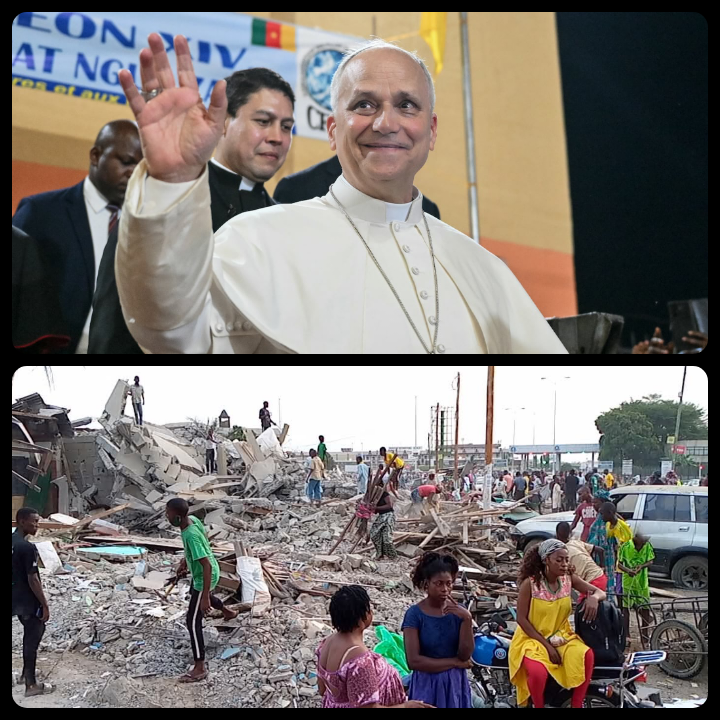
In Nkolbisson, dozens of small roadside businesses were demolished ahead of the Pope’s movement. Traders say the operation came without warning, leaving them no time to salvage goods or prepare alternative arrangements.
“He came for others and not for us,” said a visibly distressed trader, Vivianne Ngoh, standing beside the remains of her wooden stall. “They enjoyed the visit, but we are the ones suffering now.”
Many of those affected had taken loans to build their businesses. With their only source of income destroyed, repayment has become impossible. Others say their participating in their weekly \"Njangi\", the local savings system that sustains many families, has been disrupted.
“This shop was everything to my family,” another trader, Brice Njeuga, explained. “Now it is gone. We do not know how we will survive.”
In Douala, similar complaints have emerged. Along major roads cleared for the Pope’s convoy, businesses were either removed or forced to shut down. For some, the impact has gone beyond lost sales.
Linus Tanda, a mechanic based in the city, narrated how three vehicles belonging to his customers were seized by municipal police, far inside the neighborhood not even close to the road.
“They said the cars were parked on the road where the Pope would pass,” he said. “Now I am being asked to pay 25000frs for each car.”
Tanda says he has no choice but to borrow money to retrieve the vehicles afrer receiving a police summons from on of his customers who needed her car urgently.
“My children’s school fees are not even complete,” he added. “Now this problem has come. I am not even Catholic. Why should this visit put my family in such difficulty?”
In Bamenda, residents report that the situation has been equally painful. Images circulating online show shops and homes being brought down, with affected individuals seen crying and lamenting as bulldozers carried out demolitions.
Among them is Mama Lum, a trader who had been struggling to rebuild her life deapite the Anglophone crisis.
“I suffered before and started again small small,” she said. “Now everything is destroyed again. What will I do?”
Across the cities visited, movement restrictions added to the hardship. Roads were blocked for extended periods, forcing many to walk long distances to work. In Yaoundé, business owners along the Odza-Mvan stretch of road say they were compelled to close their shops for hours each day during the Pope’s movements to and from the airport.
“We lost customers every day,” one shop owner said. “For people who depend on daily sales, this is serious.”
Beyond the immediate impact on livelihoods, questions are also being raised about the cost of the visit. Analysts argue that significant public funds were mobilized for preparations, including road repairs and urban clean up efforts.
“They quickly fixed roads and painted areas because the Pope was coming,” Roger Manga, a resident in Mvolyé noted. “Why can this not be done for citizens in normal times?”
Cameroon’s religious diversity has further fueled the debate.
While the visit held deep meaning for Catholic faithful, others question why its consequences were felt across the entire population, including those of different faiths or none at all.
“He is the head of the Catholic Church,” another resident said. “But we all paid the price.”
Despite the scale of the visit, many say it has not addressed the pressing challenges facing the country. The cost of living remains high. Access to basic services continues to be a struggle in many communities. Insecurity in the Northwest and Southwest regions persists, with reports of violence continuing even on the day the Pope departed.
For those who lost businesses, homes, or income, the visit has become a painful memory rather than a moment of blessing.
“They came, they prayed, and they left,” Prisca Mboh, an affected trader said quietly. “But we are the ones left to suffer the consequences.”
As the country reflects on the visit, the voices from the streets present a stark contrast to official narratives. For many Cameroonians, the question remains unresolved.
Who truly benefited, and at what cost?
Published on: April 23, 2026