NON-PAYMENT OF TAXES, INSECURITY UNDERMINE MUYUKA COUNCIL REVENUE
By Clarrise Ekowe in Muyuka
Revenue mobilisation at the Muyuka Council continues to suffer significant setbacks, with authorities blaming weak tax compliance, institutional gaps and persistent insecurity for falling short of projections in 2025.
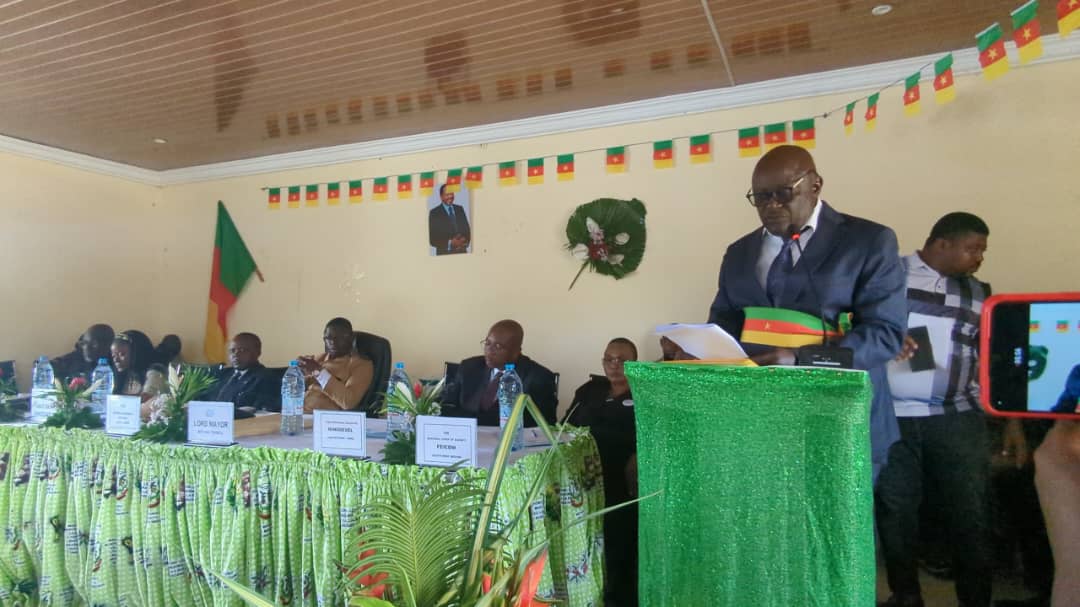
This was disclosed during the council’s first ordinary session devoted to examining and adopting the administrative, management and stores accounts for the 2025 financial year, held at the council premises on Thursday, April 16, 2026.
Presenting the financial report, the Lord Mayor of Muyuka, Lantino Jombe Hazard, revealed that out of a projected budget of CFA 1 billion, the council realised CFA 790,866,578, representing a 79.1 percent execution rate. While this marks a considerable effort under difficult circumstances, it also exposes structural weaknesses in local revenue generation.
The Mayor attributed the shortfall largely to the absence of state tax authorities in the მუნიციპალity, following the implementation of the new local taxation reform signed on December 23, 2024, by the Ministers of Finance and Decentralisation. The reform effectively strips councils of direct tax collection powers, transferring the responsibility to state tax services.
In Muyuka, however, those services are yet to establish a functional presence.
“The year 2025 was extremely difficult. The taxation services that were supposed to accompany us in collecting local taxes have not resumed work in Muyuka,” the Mayor said, underscoring the council’s limited room for manoeuvre under the current legal framework.
Compounding the problem is widespread tax non-compliance among residents, a challenge authorities say is exacerbated by a liquidity crunch and declining economic activity.
The security situation in Muyuka, located in Cameroon’s conflict-hit South-West Region, has further constrained revenue mobilisation. Years of the Anglophone crisis, marked by prolonged “ghost town” operations and instability, have disrupted economic life and weakened the tax base.
Despite these constraints, local authorities insist efforts to sustain development initiatives have not been abandoned.
The session also highlighted prospects for economic recovery through agriculture. A representative of FEICOM encouraged councillors to leverage Muyuka’s agricultural potential, pointing to successful agro-processing initiatives in neighbouring divisions such as Kupe Muanenguba. She urged the council to seek funding and invest in value addition as a pathway to increasing internally generated revenue.
In a related development, the Mayor announced the signing of a partnership agreement with FEICOM for the construction of low-cost housing estates in Muyuka—an initiative aimed at addressing the municipality’s housing deficit.
Administrative authorities present at the session struck a cautiously optimistic tone. The Senior Divisional Officer for Muyuka commended the council for adhering to budgetary discipline in line with the General Code of Regional and Local Authorities, noting that the 2025 performance reflects an improvement on the previous year.
However, officials were unanimous that without the effective deployment of state tax services and a stabilisation of the security environment, councils like Muyuka will continue to operate below their fiscal potential.
Councillors, for their part, reiterated the need for stronger revenue mobilisation strategies, enhanced collaboration with tax authorities, and capacity-building programmes to improve governance and decision-making at the local level.
Published on: April 18, 2026