Papal Address at Unity Palace Exposes Deep Governance Fault Lines in Cameroon
By Lasha Kingsly
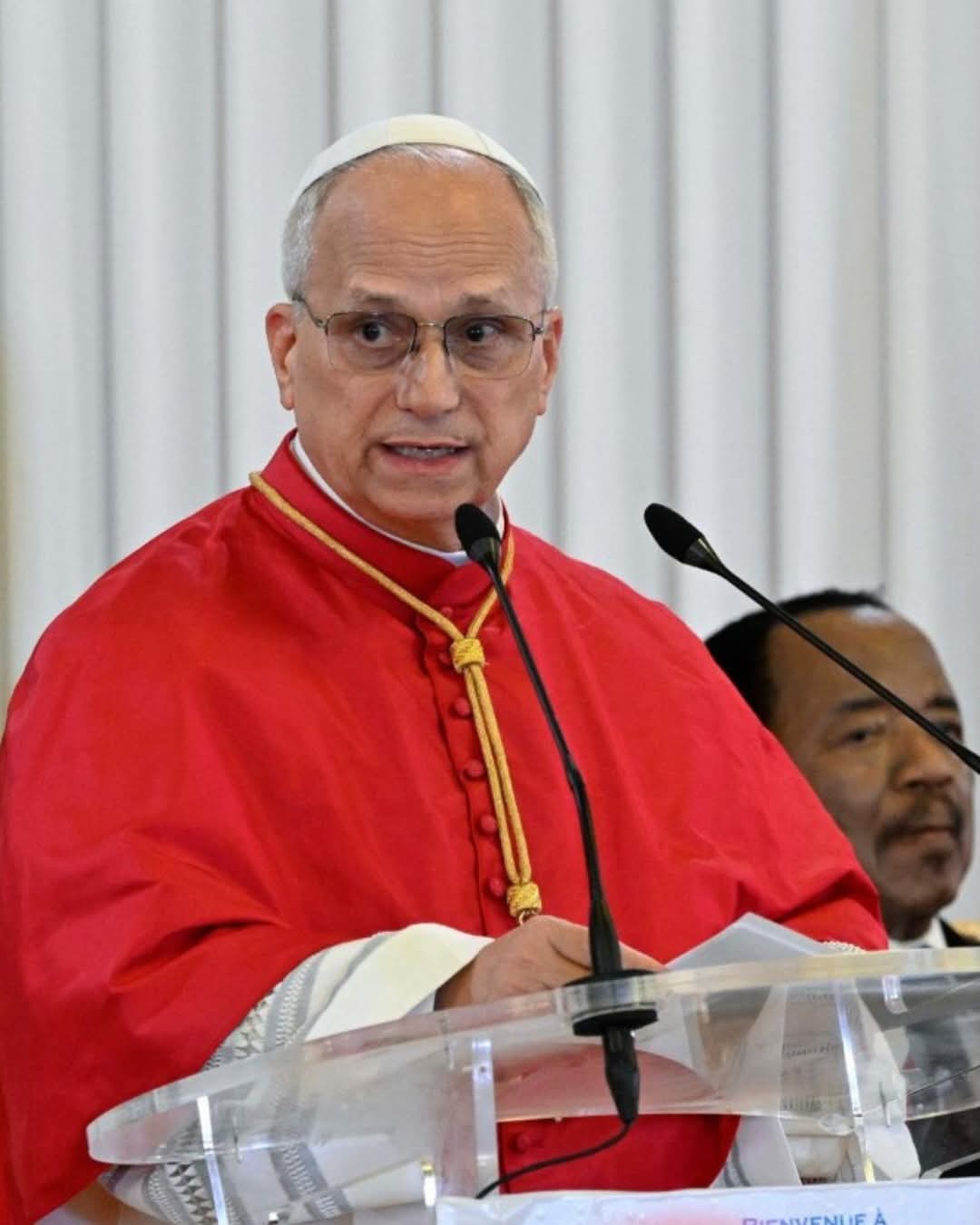
Pope Leo XIV’s address at Unity Palace in Yaoundé, last Wednesday, April 15, stands as one of the most politically resonant interventions by a religious figure in Cameroon’s recent history. Delivered before President Paul Biya, state officials, and civil society actors, the speech moved beyond ceremonial diplomacy to articulate a pointed critique of governance, social fragmentation, and the structural roots of instability in the country. While couched in the moral language of the Church, the Pope’s message functioned as a normative framework for rethinking state authority, legitimacy, and responsibility in a context marked by protracted crisis.
At its core, the address challenged the prevailing logic of governance in Cameroon. By asserting that “peace cannot be decreed” and must not be “reduced to a slogan,” Pope Leo XIV directly undermined state narratives that equate stability with top-down control or rhetorical commitment. This critique is particularly salient in a country grappling with armed conflict in the North-West and South-West regions, where official discourse has often emphasized unity and order without addressing underlying grievances. The Pope’s insistence that peace must be “welcomed and lived” reframes it as a participatory and relational process, requiring trust, justice, and sustained dialogue rather than administrative proclamation.
A central pillar of the Pope’s argument is the ethical obligation of governance to transcend partisan and elite interests. His call for “authentic peace” built beyond narrow political considerations implicitly critiques systems of patronage and exclusion that have long characterized Cameroon’s political landscape. By urging leaders to consider minorities and marginalized populations, he foregrounds the question of inclusivity as essential to national cohesion. This is particularly relevant in a multi-ethnic state where perceptions of political and economic marginalization have fueled discontent and, in some cases, violent resistance.
Equally significant is the Pope’s emphasis on institutional integrity. His appeal for transparency in the management of public resources, adherence to the rule of law, and a “merciless” fight against corruption addresses longstanding governance deficits. Corruption and abuse of power are not merely administrative failures; they erode public trust and weaken the social contract between citizens and the state. In highlighting these issues, the Pope situates moral governance as a prerequisite for political stability, suggesting that without accountability, efforts at peacebuilding will remain superficial.
The address also identifies socio-economic exclusion—particularly among youth—as a critical driver of instability. By linking unemployment and marginalization to violence, the Pope aligns with a broader body of scholarship that views economic disenfranchisement as a catalyst for unrest. His call for investment in education, vocational training, and entrepreneurship reframes development policy as a security imperative. This perspective challenges authorities to move beyond short-term political management toward long-term structural transformation aimed at integrating young people into the national economy.
Another notable dimension of the speech is its advocacy for a more participatory model of governance. The Pope’s insistence that civil society be treated as a “vital force” in rebuilding the social fabric signals a shift away from state-centric approaches. By emphasizing the need to “listen to citizens” and value their contributions, he critiques technocratic and paternalistic policy frameworks that exclude grassroots actors. This position resonates with contemporary governance theory, which underscores the importance of inclusive decision-making processes in fostering legitimacy and sustainable peace.
Furthermore, the Pope’s reference to the “wounds of the past” and their potential transformation into “sources of renewal” introduces a reconciliatory dimension to his message. This notion implies the necessity of confronting historical injustices—whether political, social, or economic—as part of a broader healing process. It suggests that durable peace in Cameroon will depend not only on policy reforms but also on mechanisms of dialogue, acknowledgment, and possibly transitional justice.
President Paul Biya’s welcoming remarks, in contrast, remained firmly within the bounds of diplomatic protocol, emphasizing hospitality and the symbolic significance of the papal visit. The juxtaposition of these remarks with the Pope’s substantive critique highlights a broader tension between ceremonial statecraft and the urgent need for reform. While the government projects stability and continuity, the papal address underscores systemic vulnerabilities that require immediate and concrete action.
In sum, Pope Leo XIV’s speech at Unity Palace can be interpreted as both a moral exhortation and a political critique of Cameroon’s governance trajectory. It articulates a vision of leadership grounded in service, inclusivity, accountability, and dialogue—principles that stand in implicit contrast to prevailing practices. By addressing issues ranging from corruption and institutional weakness to youth exclusion and armed conflict, the Pope offers a comprehensive framework for national renewal. Whether this intervention will translate into policy shifts remains uncertain, but its significance lies in its clarity: it reframes Cameroon’s challenges not as isolated problems, but as interconnected manifestations of a deeper governance crisis requiring transformative change.
Published on: April 18, 2026