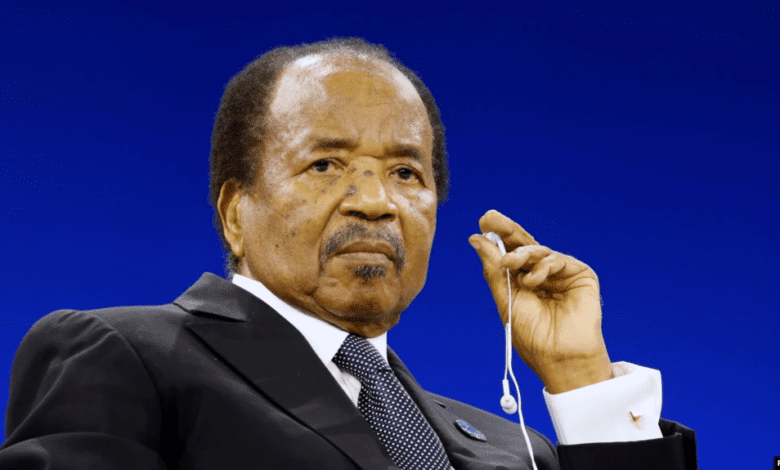
PAUL BIYA:AN ANGLOPHONE CAN ALSO BE VICE-PRESIDENT
By Prince Mundi
Cameroon has taken a decisive institutional turn with the adoption of the bill reintroducing the post of Vice-President, an office that now stands at the heart of power, succession, and national stability. But beyond the legal text and parliamentary procedure, the real question shaking public opinion is this: who should occupy that office?
In a country still grappling with a deep Anglophone crisis, the answer is not neutral. It is political. It is historical. And above all, it is a test of President Paul Biya’s legacy.
The new law gives the Head of State sweeping authority to appoint the Vice-President, a figure who could immediately assume power in the event of a vacancy at the presidency. In effect, President Biya is no longer just shaping government, he is shaping the future leadership of Cameroon. That decision cannot be divorced from the country’s fragile national fabric.
Across the Anglophone regions, the expectation is rising, and it is loud. From elites to MPs, from ministers to the common man on the streets of Buea, Bamenda, and Kumba, there is a shared cry: this is the moment to correct history. Many Anglophones openly say they are eager, even desperate, to see one of their own occupy the Vice-Presidency. For them, it would not just be an appointment; it would be recognition.
For years, the position of Prime Minister, often held by an Anglophone, has been widely perceived as largely symbolic, with limited executive power. The real authority has remained concentrated elsewhere. This perception has only deepened feelings of marginalization and neglect among Anglophones, who believe their place within the union has steadily diminished.
That is why, for many observers, the moment calls for more than routine political calculation. It calls for a deliberate act of national rebalancing.
An Anglophone Vice-President is no longer just an option, it is increasingly being framed as a necessity.
To understand why, one must return to the very foundation of Cameroon. The nation that exists today was born in 1961, not as a unitary state, but as a union between two distinct political and cultural entities: former British Southern Cameroons and French Cameroun. The agreement that followed was not merely administrative; it was a pact of coexistence.
At the time, that balance was clearly reflected at the summit of the state. A Francophone President, Ahmadou Ahidjo, worked alongside an Anglophone Vice-President, John Ngu Foncha. That arrangement was not cosmetic, it was the visible expression of a fragile but deliberate unity.
Over the years, that balance has faded.
The abolition of the federal system in 1972 centralized power and gradually erased the institutional safeguards that once reassured Anglophones of their place within the union. The disappearance of the Vice-Presidency removed one of the strongest symbols of that shared governance.
What followed is now well documented: growing frustration, deepening mistrust, and eventually, a crisis that has cost lives and fractured national cohesion. Today, many Anglophones still feel sidelined in key national decisions, their identity and concerns insufficiently reflected at the highest levels of power.
Yet within this crisis lies an opportunity.
Many Anglophones believe that appointing one of their own as Vice-President could become a turning point, not a complete solution, but a powerful confidence-building measure. Some even argue it could help draw fighters out of the bushes and create space for genuine dialogue, by showing that the state is ready to act, not just speak.
Today, with the Vice-President position restored, Cameroon stands at a crossroads. The country can either repeat the omissions of the past or consciously correct them.
This is where President Biya’s role becomes decisive.
After more than four decades in power, he is not just governing the present, he is defining how history will remember him. The reintroduction of the Vice-Presidency offers him a rare political instrument: the ability to send a strong, unmistakable signal of inclusion.
Appointing an Anglophone to that office would not solve the crisis overnight. But it would do something equally important—it would acknowledge, at the highest level of the state, that the grievances of a people are heard and taken seriously.
It would also restore, even symbolically, the original spirit of the 1961 union: a Cameroon built on dual identity, mutual respect, and shared power.
Critics may argue that competence, loyalty, or political strategy should guide the choice. They are not wrong. But in a divided nation, representation is not secondary, it is essential. Leadership in such a context must do more than govern; it must unite.
And unity, in Cameroon’s case, has always required balance.
The reality remains stark: the presidency has been held by Francophones since independence. In such a context, the Vice-Presidency naturally becomes the highest available platform to reflect the country’s Anglophone identity at the executive level.
To ignore that reality would be to ignore history itself.
The debate, therefore, is no longer abstract. It is immediate and consequential. The law has been passed. The office exists. The power to appoint lies solely with President Biya.
What remains is the choice.
A choice between continuity and correction.
A choice between symbolism and substance.
A choice that will either reinforce the perception of exclusion or begin to rebuild trust.
For many Anglophones, this is more than politics, it is a moment of truth. A moment they believe could redefine their place in the nation.
If the lesson of Cameroon’s history is to mean anything, it is this: unity cannot be decreed, it must be demonstrated.
And today, more than ever, that demonstration may well begin with a single appointment.
Published on: April 10, 2026