Three Cameroonians Sentenced in US for Sponsoring War in NW/SW
Three Cameroonians Sentenced in US for Sponsoring War in NW/SW
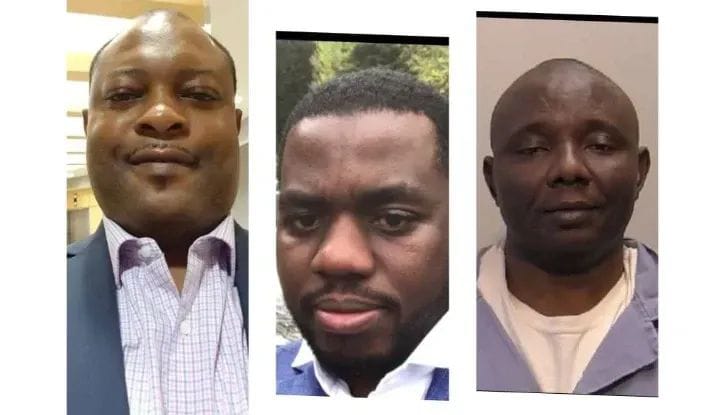
Three men of Cameroonian origin have been sentenced to a combined 35 years in prison in the United States for providing material support to separatist fighters operating in Cameroon.
The sentences were handed down on Wednesday, August 26, 2026, by a federal court in the United States and announced by the US Attorney’s Office for the Western District of Missouri.
Francis Chenyi, 52, of Saint Paul, Minnesota, and Lah Nestor Langmi, 49, of Buffalo, New York, were each sentenced to 15 years in federal prison, followed by three years of supervised release.
Claude Ngenevu Chi, 43, of Kansas City, Missouri, received a 63-month prison sentence, also followed by three years of supervised release.
According to the US Department of Justice, the three were involved in a conspiracy to provide funds, equipment and other resources to separatist fighters in Cameroon. The resources were allegedly intended to support the construction and use of improvised explosive devices (IEDs), as well as other violent activities.
Chenyi and Langmi, both US citizens of Cameroonian origin, were convicted by a federal jury after a trial. They were found guilty of conspiring to provide material support or resources intended to facilitate killings, kidnappings and maiming in a foreign country, as well as the use of weapons of mass destruction outside the United States.
They were also convicted of an international money-laundering conspiracy involving the transfer of funds from the United States to Cameroon.
Chenyi was additionally convicted of conspiring to provide material support and resources for the use of a weapon of mass destruction abroad. Chi had earlier pleaded guilty to a similar charge.
Cardinal Tumi Kidnapping
Court documents and evidence presented during the trial linked the case to the kidnapping of a traditional leader in Cameroon and the late Cardinal Christian Tumi.
According to the US Justice Department, Langmi sent an audio message to separatist fighters requesting the kidnapping of a traditional leader.
The traditional leader was later abducted following fighting between separatist fighters and Cameroonian forces. Cardinal Christian Tumi, who was travelling with the traditional leader, was also taken.
Prosecutors said Chenyi subsequently provided questions to be used during the interrogation of the traditional leader and Cardinal Tumi. He also approved the transfer of funds to separatist fighters through peer-to-peer transactions.
The court further heard that Chenyi was involved in ransom payments made by individuals outside Cameroon for the release of family members abducted in the country.
Financing of Explosives
The US authorities said the defendants were also involved in efforts to finance the production and use of explosive devices in Cameroon.
Several requests were allegedly made by co-conspirators, including Langmi, for funds to purchase materials and components for IEDs. According to prosecutors, Chenyi approved and financed some of these requests.
Chenyi also coordinated with individuals in Cameroon to facilitate training for separatist fighters in the use of IEDs.
In December 2020, Chenyi was reportedly asked to provide funds for the construction of several IEDs to support efforts to enforce a lockdown ahead of an election.
The US Justice Department said Chenyi and Chi agreed to provide the funds, with Chenyi coordinating their transfer from the United States to separatist fighters in Cameroon.
Langmi also allegedly provided funds to an unindicted co-conspirator involved in the development of IEDs and rocket-propelled grenades in Cameroon.
According to prosecutors, Langmi kept Chenyi informed about the development of the weapons and attempted to coordinate attacks around the 2021 Africa Cup of Nations, which was hosted by Cameroon, as well as in several towns and cities in the North-West Region in 2022.
The case was prosecuted by Assistant US Attorneys Sean T. Foley and Joseph M. Marquez for the Western District of Missouri, with assistance from the Justice Department’s National Security Division.
The Federal Bureau of Investigation’s Kansas City Field Office investigated the case.
By Lasha Kingsly
Published on: August 27, 2026